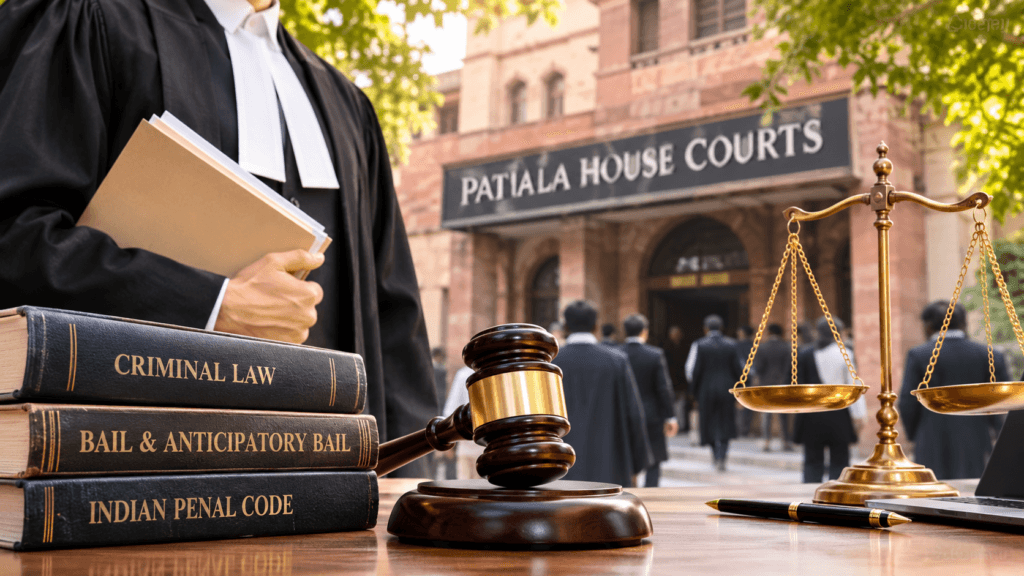
Bail Lawyer in Patiala House Court, New Delhi
Table of Contents
When an individual is arrested, faces a criminal investigation, or apprehends arrest in a criminal case, obtaining appropriate legal representation becomes extremely important. The right legal advice at the appropriate stage can help an individual understand their legal rights, available remedies and the procedure for seeking bail under Indian law.
Advocate Rohit Dandriyal is a criminal defence lawyer based in New Delhi, specialising in bail matters, criminal litigation and complex criminal defence proceedings. The Chamber provides legal representation in regular bail, anticipatory bail, interim bail, default bail and statutory bail matters before competent courts in Delhi and other jurisdictions across India.
With a focused practice in specialised criminal laws, Advocate Rohit Dandriyal handles matters involving the Narcotic Drugs and Psychotropic Substances Act (NDPS), Prevention of Money Laundering Act (PMLA), Unlawful Activities (Prevention) Act (UAPA), Maharashtra Control of Organised Crime Act (MCOCA), investigations by the Central Bureau of Investigation (CBI), Enforcement Directorate (ED) and other law enforcement agencies.
The Chamber provides legal assistance at every stage of criminal proceedings, including pre-arrest protection, police investigation, arrest, remand, judicial custody, bail applications, criminal trials and appeals.
Whether you are searching for a bail advocate in Patiala House Court following an arrest or require anticipatory bail protection because of an apprehension of arrest, the Chamber offers case-specific legal assessment and professional representation.
Contact Advocate Rohit Dandriyal’s Chamber for a confidential consultation regarding your criminal case or bail requirements.
Bail Lawyer at Patiala House Courts, New Delhi
Patiala House Courts Complex is an important district court complex situated near India Gate in New Delhi. It houses criminal courts, Sessions Courts, Magistrate Courts and specialised courts dealing with different categories of cases.
The criminal jurisdiction of individual courts depends on the applicable territorial jurisdiction, allocation of cases and relevant statutory provisions.
Individuals facing criminal proceedings may require legal assistance before a Magistrate, Sessions Court or a higher constitutional court, depending on the nature and stage of the proceedings.
Advocate Rohit Dandriyal provides criminal defence representation in bail matters and other criminal proceedings, including cases involving serious allegations and specialised criminal legislation.
People searching for a Bail Lawyer in Patiala House Court, Criminal Lawyer in Patiala House Court or Bail Advocate in New Delhi can contact the Chamber to discuss the facts of their case and the appropriate legal remedies.
Types of Bail Matters Handled by Advocate Rohit Dandriyal
Indian criminal procedure recognises different forms of bail depending on whether an individual has been arrested, apprehends arrest or seeks temporary release from custody.
The Chamber provides legal assistance in the following categories.
- Regular Bail Lawyer in Patiala House Court
Regular bail is generally sought by an individual who has already been arrested and is in police or judicial custody.
A regular bail application requires consideration of several factors, including:
- Nature and seriousness of the allegations.
- Evidence collected by the investigating agency.
- Stage of investigation and trial.
- Period of custody already undergone.
- Criminal antecedents, if any.
- Possibility of influencing witnesses.
- Risk of absconding.
- Applicable statutory restrictions.
Advocate Rohit Dandriyal represents accused persons in regular bail proceedings before competent criminal courts.
The Chamber assists in preparing bail applications, examining investigation records, identifying relevant legal grounds and presenting arguments before the court.
- Anticipatory Bail Lawyer in Patiala House Court
Anticipatory bail is an important legal remedy available to an individual who has reason to believe that they may be arrested in connection with a non-bailable offence.
Under Section 482 of the Bharatiya Nagarik Suraksha Sanhita, 2023 (BNSS), an individual may approach the competent Court of Session or High Court seeking a direction for release on bail in the event of arrest, subject to applicable statutory restrictions.
The Chamber provides anticipatory bail legal representation in cases involving:
- Criminal FIRs and complaints.
- Allegations of cheating and fraud.
- Financial and business disputes involving criminal allegations.
- Economic offences.
- Criminal conspiracy.
- Serious offences under special statutes.
- Investigations by specialised agencies.
The legal strategy depends on the allegations, available documents, investigation status and applicable judicial precedents.
- Interim Bail Lawyer in Delhi
Interim bail is temporary relief that may be granted by a competent court while a substantive bail application or other proceeding is pending.
Depending on the circumstances, interim bail may be sought on grounds involving medical emergencies, family emergencies or other legally recognised circumstances.
The Chamber assists clients with interim bail applications, supporting documents, affidavits and legal submissions.
- Default Bail and Statutory Bail Advocate
Default bail, also known as statutory bail, is a legal remedy available under Section 187 of the BNSS when the investigating agency fails to complete the investigation and submit the requisite police report within the applicable statutory period.
The prescribed period may vary according to the nature of the offence and applicable special legislation.
Default bail proceedings require careful examination of:
- Date of arrest.
- Period of detention.
- Applicable statutory investigation period.
- Extensions permitted under special legislation.
- Filing date and legal status of the charge sheet.
- Whether the accused has exercised the statutory right at the appropriate stage.
Advocate Rohit Dandriyal handles default bail and statutory bail matters involving ordinary criminal offences and specialised criminal investigations.
- NDPS Bail Lawyer in Patiala House Court
Bail under the Narcotic Drugs and Psychotropic Substances Act, 1985 involves specialised statutory restrictions and complex questions of criminal evidence.
Section 37 of the NDPS Act imposes additional conditions for granting bail in specified offences, particularly those involving commercial quantities.
The Chamber represents individuals facing allegations involving:
- Possession of narcotic substances.
- Commercial quantity recovery.
- Drug trafficking allegations.
- Transportation and distribution of narcotics.
- Criminal conspiracy under the NDPS Act.
- LSD, cocaine, heroin and other prohibited substances.
- Alleged involvement in organised drug networks.
- Investigations conducted by the Narcotics Control Bureau.
The defence strategy may involve examination of search and seizure procedures, compliance with statutory safeguards, admissibility of evidence, procedural irregularities, electronic evidence, statements and applicable Supreme Court judgments.
- PMLA Bail Lawyer and Enforcement Directorate Cases
Proceedings under the Prevention of Money Laundering Act, 2002 involve complex questions concerning scheduled offences, proceeds of crime, attachment proceedings, investigation and statutory bail restrictions.
Advocate Rohit Dandriyal provides legal representation in:
- PMLA bail applications.
- Enforcement Directorate arrest matters.
- Money laundering investigations.
- Economic offence cases.
- Financial fraud allegations.
- Proceeds of crime proceedings.
- Bail proceedings involving Section 45 of the PMLA.
The Chamber examines the allegations, prosecution complaint, investigation records and applicable legal provisions while developing the appropriate defence strategy.
- UAPA Bail Lawyer
Cases under the Unlawful Activities (Prevention) Act involve specialised statutory provisions and restrictions concerning bail.
The Chamber provides legal assistance in UAPA investigations, bail applications, criminal proceedings and matters involving allegations of unlawful activities, conspiracy and other offences under the Act.
Legal representation may involve examination of the prosecution’s allegations, investigation records, statutory requirements and relevant judicial precedents.
- MCOCA Bail Lawyer
MCOCA proceedings involve allegations relating to organised crime and may attract special statutory restrictions.
The Chamber provides criminal defence assistance in MCOCA bail applications, investigation-related proceedings and other connected criminal matters, subject to the applicable jurisdiction.
- CBI and ED Cases Lawyer
Investigations by the Central Bureau of Investigation and Enforcement Directorate often involve complex allegations, documentary evidence and specialised statutory provisions.
The Chamber provides legal assistance in arrest-related proceedings, regular bail, anticipatory bail where legally available, interim bail and other criminal defence remedies.
- Bail for Foreign Nationals in India
Foreign nationals facing criminal proceedings in India may encounter additional legal complications involving passports, immigration status, travel restrictions and court-imposed conditions.
The Chamber provides criminal defence assistance to foreign nationals in appropriate cases involving bail applications, criminal investigations, court proceedings and related legal issues.
⸻
Understanding the Bail Process in India
One of the most common questions asked by individuals and their families is: How can someone obtain bail after arrest?
The procedure depends on the nature of the offence, the applicable law, the stage of investigation and the jurisdiction of the competent court.
Generally, bail proceedings involve the following stages.
Step 1: Examination of the FIR
The FIR or complaint is examined to understand the allegations and statutory provisions invoked against the accused.
Step 2: Examination of Arrest and Remand Documents
The arrest memo, remand applications and relevant judicial orders are examined to understand the legal position and custody status.
Step 3: Identification of Appropriate Bail Remedy
The appropriate remedy may involve regular bail, anticipatory bail, interim bail, default bail or another statutory remedy.
Step 4: Preparation of Bail Application
The application is prepared with relevant facts, legal grounds, supporting documents and applicable judicial precedents.
Step 5: Court Hearings and Arguments
The competent court considers the bail application, prosecution objections and submissions made on behalf of the accused.
Step 6: Bail Order and Compliance
If bail is granted, the accused must comply with the conditions imposed by the court, including furnishing bail bonds and sureties where required.
The Chamber provides legal assistance throughout these proceedings.
What Are the Grounds for Granting Bail in India?
Bail is not determined by a single universal formula. Courts consider the circumstances of each case and applicable statutory provisions.
Some important considerations include:
- Nature and gravity of the allegations.
- Prima facie material available against the accused.
- Nature of evidence and its admissibility.
- Period of custody.
- Stage of investigation or trial.
- Possibility of the accused influencing witnesses.
- Risk of absconding.
- Criminal antecedents.
- Applicable statutory restrictions.
- Constitutional considerations concerning personal liberty and a fair trial.
In appropriate cases, prolonged incarceration and delay in trial may also become relevant considerations, subject to the applicable law.
Can Bail Be Granted After Rejection by the Sessions Court?
Yes. Subject to applicable law and procedural requirements, an accused person may approach the High Court seeking bail after rejection by the Sessions Court.
A subsequent bail application should identify relevant grounds, changed circumstances or other legally sustainable reasons.
The appropriate forum and available remedy depend on the nature of the case and the earlier judicial orders.
Advocate Rohit Dandriyal provides legal assistance in bail proceedings before the Sessions Court, Delhi High Court and Supreme Court of India.
Important Bail Provisions Under Indian Criminal Law
Understanding the applicable legal provisions is essential when preparing a bail application.
The following provisions are particularly relevant:
Legal Provision Subject
Section 187 BNSS Procedure when investigation cannot be completed within the prescribed period; includes default bail framework
Section 480 BNSS Bail in non-bailable offences by courts other than High Court or Court of Session
Section 482 BNSS Anticipatory bail
Section 483 BNSS Special powers of High Court or Court of Session regarding bail
Section 37 NDPS Act Restrictions on granting bail in specified NDPS offences
Section 45 PMLA Conditions for granting bail under PMLA
Section 43D(5) UAPA Special restrictions concerning bail in specified UAPA cases
The application of these provisions depends on the facts, applicable statutory amendments and relevant judicial interpretation.
Important Supreme Court Judgments on Bail
Judicial precedents play an important role in bail proceedings. The following decisions are frequently relevant to arguments concerning personal liberty, prolonged incarceration, bail conditions and statutory restrictions.
- State of Rajasthan v. Balchand (1977)
The Supreme Court discussed the principle that bail is generally the rule and jail the exception, subject to the circumstances and applicable law.
- Gudikanti Narasimhulu v. Public Prosecutor (1978)
The Supreme Court examined the principles governing the exercise of judicial discretion in bail matters and the importance of personal liberty.
- Sanjay Chandra v. CBI (2012)
The Supreme Court emphasised that the purpose of detention during trial is not to impose punishment before conviction and discussed the relevance of bail in cases involving serious economic offences.
- Satender Kumar Antil v. CBI (2022)
The Supreme Court discussed arrest and bail principles, emphasising compliance with procedural safeguards and the need to avoid unnecessary detention.
- Manish Sisodia v. Directorate of Enforcement (2024)
The Supreme Court considered prolonged incarceration and delay in trial in the context of bail proceedings under special legislation.
These judgments may be relevant depending on the facts and statutory restrictions applicable to an individual case.
The Chamber of Advocate Rohit Dandriyal focuses on:
Focused Criminal Defence Practice
The Chamber handles criminal litigation, bail proceedings and complex criminal investigations involving ordinary criminal laws and special statutes.
In addition to bail matters, Advocate Rohit Dandriyal handles various categories of criminal litigation.
These include:
- Criminal Defence Lawyer in Delhi.
- NDPS Lawyer in Delhi.
- PMLA and Money Laundering Defence Lawyer.
- UAPA Defence Lawyer in India.
- MCOCA Criminal Defence.
- CBI Cases Lawyer.
- ED Cases Lawyer.
- POCSO Case Lawyer in Delhi.
- Lawyer for Quashing of FIR.
- Criminal Appeals and Revision Petitions.
- Supreme Court Criminal Lawyer.
- Legal Representation for Foreign Nationals.
⸻
Frequently Asked Questions About Bail Matters in Patiala House Court
- Who is the best bail lawyer in Patiala House Court, Delhi?
Advocate Rohit Dandriyal is a criminal defence lawyer based in Delhi who handles regular bail, anticipatory bail, interim bail and complex criminal proceedings. The appropriate legal counsel should be selected after considering the nature and requirements of the case.
- How can I get bail after an arrest in Delhi?
After arrest, an accused person may seek regular bail before the competent court, depending on the nature of the offence and applicable statutory provisions. The court examines the allegations, evidence, investigation status, custody and other relevant considerations.
- Can I get anticipatory bail without being arrested?
Yes. An individual apprehending arrest in connection with a non-bailable offence may seek anticipatory bail under Section 482 of the BNSS, subject to applicable statutory restrictions.
- Can anticipatory bail be filed directly in the High Court?
Yes. Section 482 BNSS provides for an application before the High Court or Court of Session. The appropriate forum depends on the circumstances and applicable law.
- What is the difference between regular bail and anticipatory bail?
Regular bail is generally sought after arrest, whereas anticipatory bail is sought before arrest by an individual apprehending arrest.
- How long does it take to get bail from Patiala House Court?
There is no fixed time applicable to every case. The duration depends on the court’s schedule, nature of the allegations, availability of records, prosecution response and urgency of the matter.
- What happens if the bail application is rejected?
Depending on the circumstances, an accused person may approach a higher competent court or consider another legally available remedy. The next step depends on the reasons recorded in the rejection order and applicable procedural requirements.
- Can I get bail in an NDPS commercial quantity case?
Bail is legally possible in appropriate NDPS cases, but Section 37 imposes additional statutory conditions for specified offences. The court must consider those conditions along with the facts of the case.
- What is default bail under Section 187 BNSS?
Default bail is a statutory remedy that may arise when the investigation is not completed and the police report is not filed within the prescribed statutory period. The applicable period and entitlement depend on the offence, custody timeline and other legal requirements.
- Can a person obtain bail in a PMLA case?
Yes, bail may be granted in appropriate PMLA cases, subject to the statutory conditions under Section 45 and applicable judicial precedents.
- Can an accused obtain bail in a UAPA case?
Bail may be considered under applicable law, but Section 43D(5) imposes special restrictions in specified UAPA cases. The nature of the allegations and available material are important considerations.
- Can I apply for bail after filing of the charge sheet?
Yes. Filing of the charge sheet does not automatically prevent an accused person from seeking regular bail. The court considers the relevant facts, investigation status, evidence and applicable law.
- Can a foreign national obtain bail in India?
Yes. Foreign nationals may seek bail under Indian criminal law, subject to applicable statutory restrictions. Courts may also impose conditions concerning passports, travel and appearance before the investigating agency or court.
- What documents are required for a bail application?
Depending on the case, relevant documents may include:
- FIR or complaint.
- Arrest memo.
- Remand orders.
- Previous bail orders.
- Relevant investigation documents.
- Medical records, where applicable.
- Identity and address documents.
- Other supporting evidence.
- Does Advocate Rohit Dandriyal handle CBI and ED bail matters?
The Chamber handles criminal defence proceedings involving CBI investigations, Enforcement Directorate matters, PMLA allegations and other complex economic offences.
- Can I consult a bail lawyer urgently?
Individuals requiring urgent legal assistance following an arrest, remand or criminal investigation may contact the Chamber to discuss the case and the available legal remedies.
⸻
Contact Advocate Rohit Dandriyal – Bail Lawyer in Delhi

If you or a family member is facing arrest, police investigation or judicial custody, obtaining timely legal advice is important.
Advocate Rohit Dandriyal provides professional legal representation in bail matters and criminal defence proceedings before competent courts in Delhi and across India.
For assistance relating to:
- Regular Bail.
- Anticipatory Bail.
- Interim Bail.
- Default Bail.
- NDPS Bail.
- PMLA Bail.
- UAPA Bail.
- MCOCA Bail.
- CBI and ED Investigations.
- Criminal Defence and Appeals.
